1

“You asked me to explain why I am afraid of a draught of cool air; why I shiver more than others upon entering a cold room, and seem nauseated and repelled when the chill of evening creeps through the heat of a mild autumn day. There are those who say I respond to cold as others do to a bad odour, and I am the last to deny the impression. What I will do is to relate the most horrible circumstance I ever encountered, and leave it to you to judge whether or not this forms a suitable explanation of my peculiarity.”–H. P. Lovecraft

“What do we know,” he had said, “of the world and the universe about us? Our means of receiving impressions are absurdly few, and our notions of surrounding objects infinitely narrow. We see things only as we are constructed to see them, and can gain no idea of their
absolute nature. With five feeble senses we pretend to comprehend the boundlessly complex
cosmos, yet other beings with a wider, stronger, or different range of senses might not only
see very differently the things we see, but might see and study whole worlds of matter, energy, and life which lie close at hand yet can never be detected with the senses we have. I have always believed that such strange, inaccessible worlds exist at our very elbows, and
now I believe I have found a way to break down the barriers. I am not joking. Within twenty-four hours that machine near the table will generate waves acting on unrecognized sense organs that exist in us as atrophied or rudimentary vestiges. Those waves will open up to us many vistas unknown to man, and several unknown to anything we consider organic life. We shall see that at which dogs howl in the dark, and that at which cats prick up their ears after midnight. We shall see these things, and other things which no breathing creature has yet
seen. We shall overleap time, space, and dimensions, and without bodily motion peer to the bottom of creation.”–H.P. Lovecraft
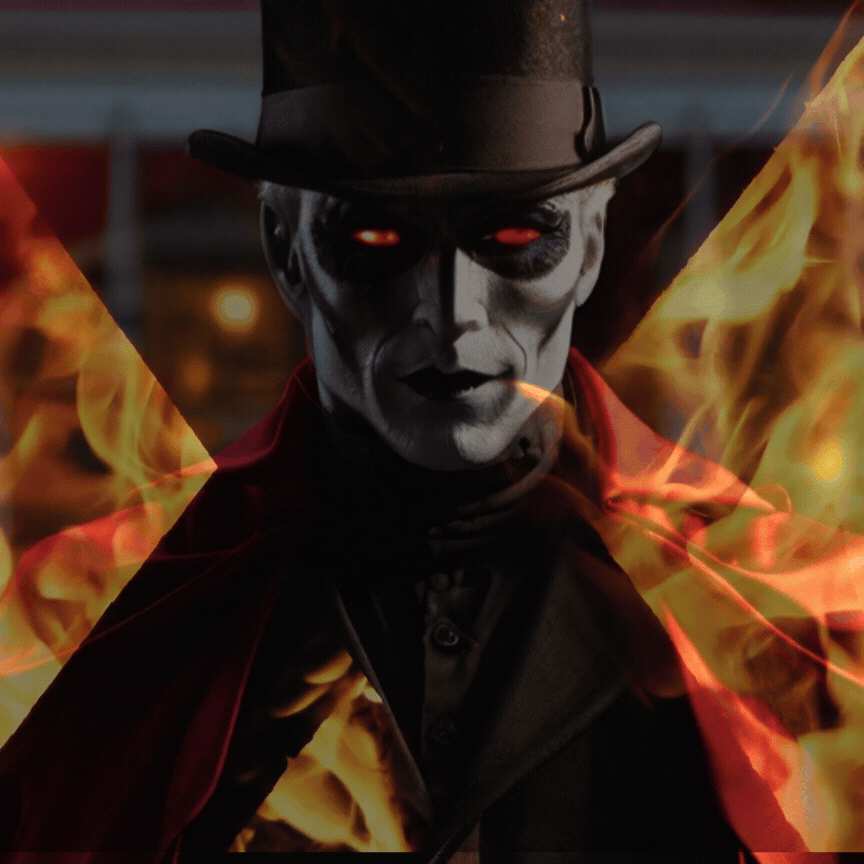
The creeping introduction of “Fane of the Black Pharaoh” as stated by Weird Tales says:
“Those eyes shone through the shadows; unwinking, unchanging, omniscient in this little world of the dead.”

But…Robert Bloch’s introduction brought more blood and fang:
“Terrible was the fame of Nephren-Ka, and more terrible still was the destiny that Captain Cartaret read on the walls of the red-litten underground corridors.”

The aged mariner may proclaim, “And on the first winter breaker…of Grand Isle’s coldest winter, Pierre Santiny plunged into the sea and was seen no more.”
Then, the teller of the tale may pause with haunting eyes as the fires crack in the bonfire, the sea roars, and the wind howls with possibly an ancient chime. With a whispering voice on the third crash of a wave they may even say, “But none on the island will ever say he died.”–JL

A legend haunts the town of Grand Isle. Aged mariners proclaim by roaring bonfires along the coast, “And on the first winter breaker…of Grand Isle’s coldest winter, Pierre Santiny plunged into the sea and was seen no more.”
Then, the teller of the tale may pause with haunting eyes as the fires crack in the bonfire, the sea roars, and the wind howls with possibly an ancient chime. With a whispering voice on the third crash of a wave they may even say, “But none on the island will ever say he died.”
Will Marty Santiny—son of Pierre Santiny, discover what really happened to his father? Or will the town continue to fear the legend of “The Mariner of Caminada Pass”?

I would not die, and leave no name behind. Three centuries have passed since I quaffed the fatal beverage: another year shall not elapse before, encountering gigantic dangers–warring with the powers of frost in their home–beset by famine, toil, and tempest–I yield this body, too tenacious a cage for a soul which thirsts for freedom, to the destructive elements of air and water–or, if I survive, my name shall be recorded as one of the most famous among the sons of men; and, my task achieved, I shall adopt more resolute means, and, by scattering and annihilating the atoms that compose my frame, set at liberty the life imprisoned within, and so cruelly prevented from soaring from this dim earth to a sphere more congenial to its immortal essence.